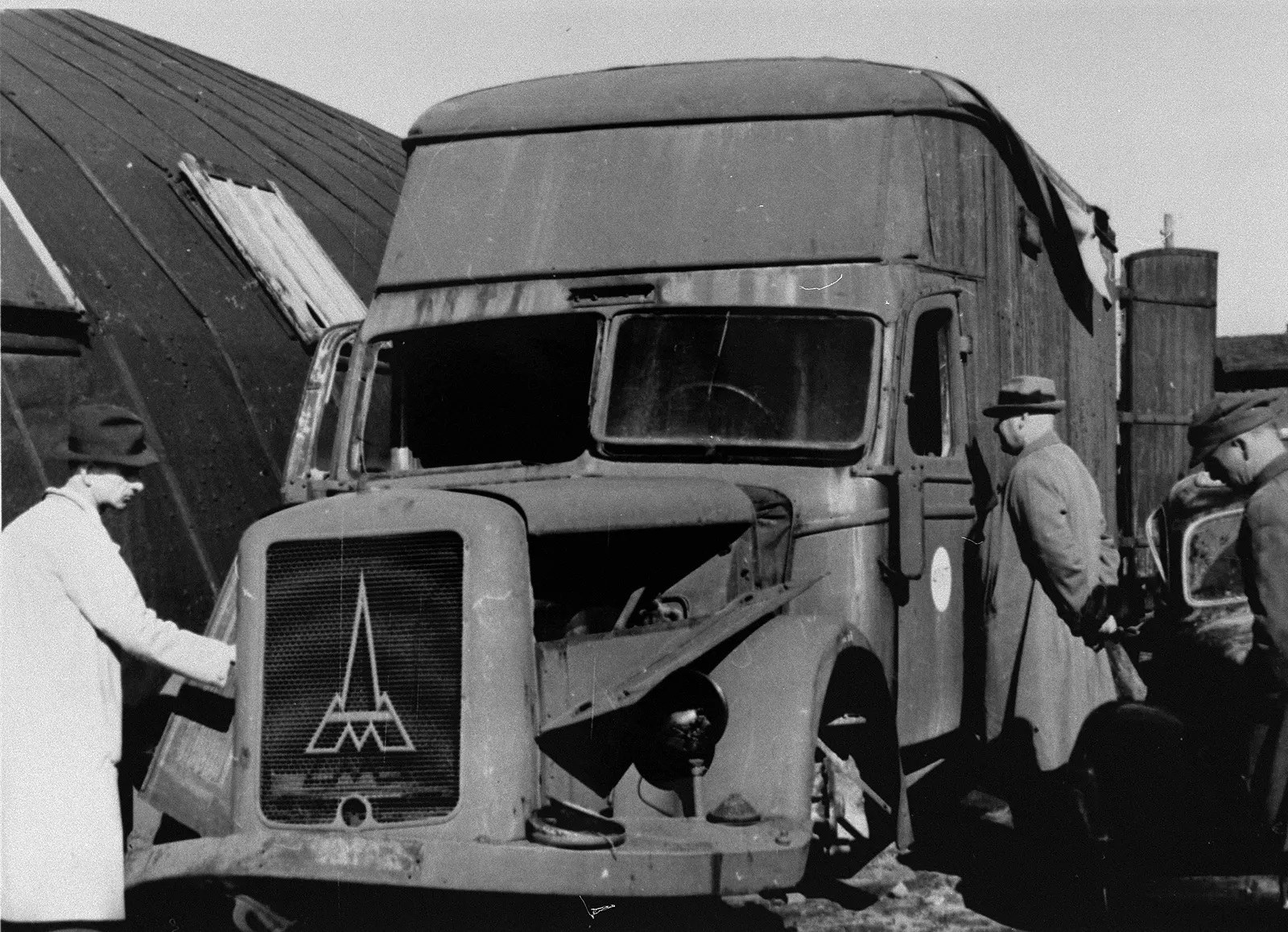
A Magirus-Deutz gas van of the type used for murder at Chełmno; the exhaust fumes were diverted into the sealed rear compartment where the victims were locked in. This particular van had not yet been modified.
Chełmno (Kulmhof), postwar. Public domain.
- Type
- Extermination Camp
- Location
- Chełmno nad Nerem (Kulmhof), Reichsgau Wartheland, German-annexed Poland (about 40 miles northwest of Łódź)
- Operational dates
- December 1941 to April 1943, and again June 1944 to January 1945
- Liberation
- Dismantled before liberationThe SS abandoned and destroyed the camp around 17 January 1945, killing the last forced laborers as Soviet forces approached.
- Approximate prisoner count
- A killing center; the relevant figure is the number deported and murdered there. Only a small group of forced laborers was kept alive at a time.
- Approximate death toll
- At least 156,300 people, including at least 152,000 Jews and about 4,300 Roma, plus an unknown number of Poles and Soviet POWsUSHMM states 'at least 156,300.' Most victims died in the first period, over 70,000 from the Łódź ghetto alone; older estimates ran considerably higher, and this is the conservative, evidence-based minimum.
- Primary prisoner categories
- Overwhelmingly Polish Jews of the Warthegau, including tens of thousands from the Łódź ghetto and from ghettos in surrounding towns, as well as German, Austrian, Czech, and Luxembourg Jews who had been deported into the Łódź ghetto. Also about 4,300 Roma and smaller numbers of Poles and Soviet POWs.
- Commandants
- Herbert Lange, the first commandant who established the camp (until March 1942), was killed in the Battle of Berlin in April 1945 and never tried. Hans Bothmann, the second commandant who reopened the camp in 1944, died by suicide in British custody in April 1946 before he could be tried.
Chełmno, known to the Germans as Kulmhof, was the first Nazi camp established specifically for the systematic murder of Jews, beginning operations on 8 December 1941, weeks before the Wannsee Conference and the opening of the Reinhard camps. It lay in the Warthegau, the part of western Poland annexed to the Reich, and it was created chiefly to murder the Jews of that region, above all the great ghetto of Łódź; in all, at least 156,300 people died there, including some 152,000 Jews and about 4,300 Roma. Unlike the other killing centers, Chełmno had no single fenced compound but used a requisitioned manor house in the village and a clearing in the nearby forest several kilometers away. It operated in two distinct phases, 1941 to 1943 and 1944 to 1945, and was so tightly sealed that only a handful of Jewish prisoners are known to have escaped. Their testimonies, and later the survivor Szymon Srebrnik's appearance in Claude Lanzmann's Shoah, are among the few human records of a place built to leave none.