Marguerite Higgins
1920 to 1966
War correspondent, New York Herald Tribune.
Born in Hong Kong in 1920, Higgins joined the New York Herald Tribune in 1942 and persuaded the paper to send her to the European theater. Reassigned to Germany in March 1945, she reached Dachau on 29 April with the 42nd Rainbow Division and, with Peter Furst of the army newspaper Stars and Stripes, was among the first American reporters to enter the prisoner enclosure, filing one of the earliest eyewitness accounts of the camp. She received a U.S. Army campaign ribbon for her part in the surrender of the camp's SS guards. In 1951 she became the first woman to win the Pulitzer Prize for International Reporting, for her coverage of the Korean War, and she later reported from Vietnam, where she contracted the illness that killed her in 1966. She is buried at Arlington National Cemetery.
Read more: Marguerite Higgins, The Female Correspondent Who Entered Dachau With the 42nd Division
Rabbi Eli A. Bohnen
1909 to 1992
Jewish chaplain, 42nd Rainbow Division.
Eli Aaron Bohnen was born in Toronto in 1909, graduated from the University of Toronto, and was ordained at the Jewish Theological Seminary in 1935 before serving congregations in Philadelphia and Buffalo. He left his pulpit to serve as a U.S. Army chaplain with the 42nd Rainbow Division in Europe and was among the first Jewish chaplains to enter Dachau after its liberation on 29 April 1945. Weeks earlier, on 28 March 1945, he and his assistant Corporal Eli Heimberg organized a Passover seder for roughly 1,500 soldiers and civilians at Dahn, Germany, and printed the Rainbow Haggadah on the division press, believed to be among the first Jewish liturgical printings in Germany since 1933. After the war he advised the U.S. military on displaced persons, and in 1948 he became rabbi of Temple Emanu-El in Providence, Rhode Island, later leading the Rhode Island Board of Rabbis. He died in 1992.
Edmond Michelet
1899 to 1970
French Resistance leader and prisoner; later government minister.
Edmond Michelet was born in 1899 and was a leader of the Combat resistance movement in the Limousin when the Gestapo arrested him at Brive-la-Gaillarde on 25 February 1943. After months at Fresnes prison he was deported to the main Dachau camp on 15 September 1943, where he was held until liberation on 29 April 1945. Inside the camp he aided the sick through the typhus epidemic, and at liberation he represented France on the international prisoners' committee, helping organize the repatriation of French and Spanish internees. He drew on notes kept in the camp to write a postwar account of his imprisonment. After the war he served in the French parliament and as a minister under Charles de Gaulle, holding the armies and later the justice portfolios.
Lockered "Bud" Gahs
born c. 1925
Liberator, 222nd Infantry Regiment, 42nd Rainbow Division.
Lockered "Bud" Gahs, of Perry Hall, Maryland, was drafted in 1943 and served in the Anti-Tank Company of the 222nd Infantry Regiment, 42nd Rainbow Infantry Division. On 25 January 1945, during Operation Nordwind near Schweighausen, France, he held his position for more than two hours under repeated German assault, action for which he was awarded the Bronze Star. Some three months later, on 29 April 1945, he advanced into Dachau with the 222nd on the day of the camp's liberation, and he has recounted that a freed prisoner kissed his boot. A century old in 2026, he returned to Dachau on 4 May 2025 to speak at the eightieth-anniversary commemoration of the liberation by the U.S. Seventh Army's 42nd, 45th, and 20th Armored Divisions.
Watch video: A Rainbow and a Thunderbird Unite at Dachau
Ben Lesser
1928 to 2025
Holocaust survivor liberated in the main camp.
Ben Lesser was born in Kraków in 1928 and was deported as a teenager through a succession of camps, among them Auschwitz-Birkenau and Buchenwald, before a final transport carried him to the main Dachau camp on 26 April 1945. He entered the camp among the dead and dying and was inside it when U.S. forces arrived on 29 April. He settled in the United States after the war and, in his later decades, became a widely heard Holocaust educator, founding a remembrance foundation and speaking to students around the world until his death in 2025.
Read more: Ben Lesser, Dachau Survivor: The Day His Life Began Again
Georg Elser
1903 to 1945
German anti-Nazi resister killed at the camp.
Johann Georg Elser was a German carpenter who, acting alone in November 1939, built and planted a bomb in a Munich beer hall in an attempt to kill Hitler, convinced he would otherwise lead Europe into war. Hitler left the hall earlier than expected and survived, and Elser was arrested that night near the Swiss border. He was held for more than five years as a special prisoner, first at Sachsenhausen and from late 1944 in the main Dachau camp. On 9 April 1945, weeks before liberation, he was killed at Dachau on orders from Berlin, and is today recognized as one of the most determined individual opponents of the regime.
Also held at Sachsenhausen
Titus Brandsma
1881 to 1942
Dutch Carmelite priest and martyr; canonized 2022.
Titus Brandsma was a Dutch Carmelite priest, philosophy professor, and journalist who helped found the Catholic University of Nijmegen and advised the Catholic press. After the German occupation of the Netherlands he carried a bishops' instruction to Catholic newspapers to refuse Nazi propaganda, and he was arrested in January 1942. He was moved through several prisons and deported to the main Dachau camp, arriving in June 1942 and held in the barracks set aside for clergy, where he died on 26 July 1942. He was canonized by Pope Francis in 2022, and the town of Dachau named a street near the former camp in his honor.
Dan Dougherty
born c. 1925
Liberator, 157th Infantry, 45th "Thunderbird" Division.
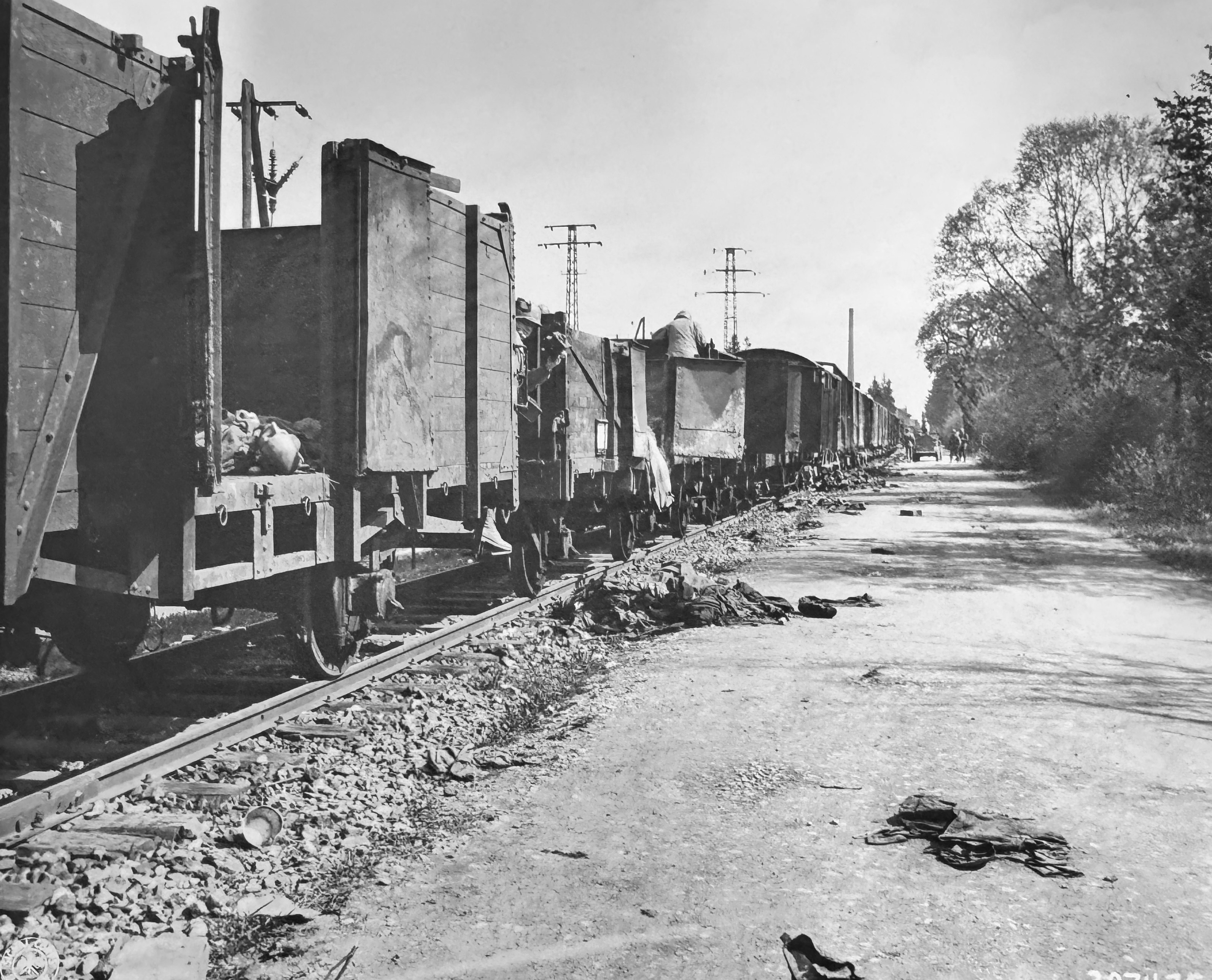
Dan Dougherty served as a squad leader with the 157th Infantry Regiment of the 45th "Thunderbird" Division, which entered the main Dachau camp on 29 April 1945 alongside the 42nd Rainbow Division. Carrying two cameras, he photographed what the troops found, including the rail cars of the dead outside the gates, and bore witness to the conditions inside. In the decades that followed he worked to preserve his company's testimony, gathering accounts from fellow soldiers, survivors, and historians, and he returned to Dachau for the liberation's later anniversaries.
Watch video: A Rainbow and a Thunderbird Unite at Dachau
Charles Delestraint
1879 to 1945
French general; first head of the Resistance Secret Army.
Charles Delestraint was a French general whom Charles de Gaulle and Jean Moulin chose in 1942 to lead the Armee secrete, the unified military arm of the French Resistance. Arrested by the Gestapo in Paris in June 1943, he was deported and eventually held in the main Dachau camp. On 19 April 1945, days before liberation, he was killed at Dachau on SS orders. He is honored in France as one of the senior soldiers of the Resistance.
Karl Leisner
1915 to 1945
German Catholic deacon secretly ordained a priest in the camp.
Karl Leisner was a German Catholic deacon arrested for a remark against Hitler and imprisoned at Dachau, where clergy from across occupied Europe were held in a dedicated barracks. In December 1944, in a secret ceremony made possible by fellow prisoners, the imprisoned French bishop Gabriel Piguet ordained him a priest, and he celebrated a single Mass inside the camp. Gravely ill with tuberculosis, he was freed in 1945 but died that August. He was beatified by Pope John Paul II in 1996.