All camps

Drancy

Drancy transit camp

The Drancy transit camp outside Paris, a U-shaped housing block ringed with barbed wire.

Bundesarchiv, Bild 183-B10919 / CC-BY-SA 3.0.

Type
Transit Camp
Location
Drancy, a northeastern suburb of Paris, France
Operational dates
Established as an internment camp August 1941; the principal transit camp for France from summer 1942 until mid-August 1944
Liberation
Mid-August 1944; German staff fled as Allied forces neared Paris, leaving about 1,500 prisoners behindDrancy was not stormed by a named liberating unit; the SS abandoned it amid the Allied advance on Paris.
Approximate prisoner count
Approximately 70,000 passed through between 1941 and 1944; about 64,000 Jews were deported in 62 transports between March 1942 and July 1944
Approximate death toll
Deaths at the camp were comparatively low; the great majority of the roughly 64,000 deportees were murdered after transport, the vast majority at Auschwitz-Birkenau and 3,000 to 4,000 at Sobibor. Fewer than 2,000 of those deported survived.Drancy was a transit and holding site, not a killing center; the deaths happened at the eastern destinations. One notable on-site death: the poet Max Jacob died at Drancy of illness in March 1944.
Primary prisoner categories
Almost entirely Jews. Some were French citizens, but the majority were foreign-born Jews who had immigrated to France in the 1920s and 1930s, primarily from Poland, Germany, and Austria. A small number of non-Jewish prisoners, mostly French resistance members, were also held.
Commandants
French police staffed the camp under German control until July 1943, when SS officer Alois Brunner became commandant; condemned to death in absentia in France in 1954, he never stood trial in person, fled to Syria, and reportedly died there around 2010 unpunished.
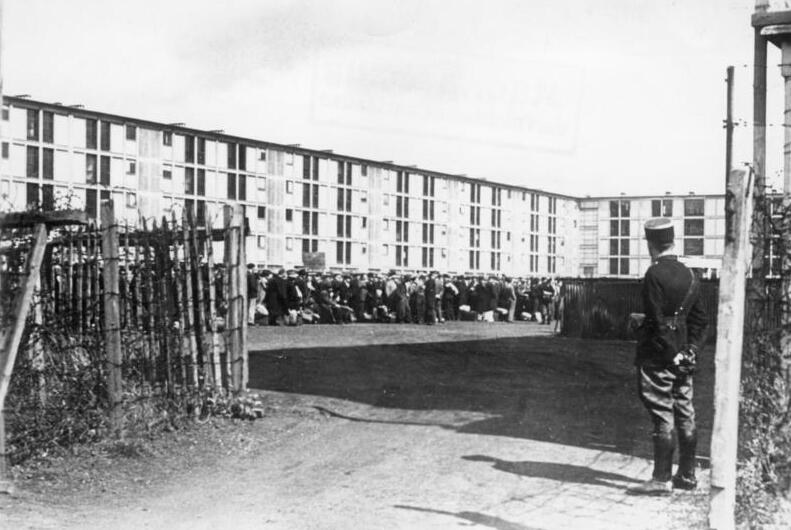
Drancy stood in a northeastern suburb of Paris, a U-shaped modernist housing block of the 1930s never finished as homes and instead ringed with barbed wire, and from the summer of 1942 it was the main door through which the Jews of France were sent east. French police ran it under German control until July 1943, when the SS officer Alois Brunner took direct command and intensified the deportations. Nearly all of its roughly 64,000 deportees were carried to Auschwitz-Birkenau, with several thousand to Sobibor. Comparatively few died at Drancy itself; it was a place of waiting before the trains, and fewer than 2,000 of those deported survived. Among those held there were some of the luminaries of French-Jewish cultural life.

The people of Drancy

Max Jacob

1876 to 1944

French avant-garde poet and painter who died at Drancy.

Max Jacob was born on 12 July 1876 in Quimper and was a French avant-garde poet, painter, and critic, a central figure of the Montmartre circle around Picasso and Apollinaire, and a Jew who had converted to Catholicism in 1915. He was arrested by the Gestapo in February 1944 and interned at Drancy, where he died of pneumonia on 5 March 1944, before he could be deported. His death at the camp is one of the comparatively rare deaths that occurred on-site rather than at the eastern destinations.

René Blum

1878 to 1942

French impresario; founder of the Ballets Russes de Monte-Carlo.

René Blum was born on 13 March 1878 in Paris and was a French literary and ballet impresario, founder of the Ballets Russes de Monte-Carlo, and the younger brother of the statesman Léon Blum. He was arrested in Paris in December 1941, held at Compiègne and then Drancy, and deported to Auschwitz in 1942, where he was killed. He is remembered as one of the prominent figures of French cultural life held at the camp.

Tristan Bernard

1866 to 1947

French playwright and humorist briefly held at Drancy.

Tristan Bernard, born Paul Bernard on 7 September 1866 in Besançon, was a French playwright, novelist, and humorist. He and his wife were arrested in 1943 and held at Drancy. He was released after intervention by admirers, with accounts citing the actor Sacha Guitry and the actress Arletty among those who lobbied for his freedom, and he survived the war, dying in 1947.

Alois Brunner

1912 to about 2001

SS commandant of Drancy, 1943 to 1944.

Alois Brunner was born on 8 April 1912 in Austria-Hungary and was a close aide to Adolf Eichmann who became commandant of Drancy in July 1943, when the Germans took direct control from the French police. He intensified deportations from the camp, and the last transport under his command, on 31 July 1944, included hundreds of children. France condemned him to death in absentia in 1954; he fled to Syria, where he lived under protection and was never extradited, and a 2017 investigation concluded he likely died in Damascus around 2001.

Subcamps

Drancy had three associated forced-labor annex sites in central Paris, described by USHMM as subcamps: Austerlitz, Lévitan, and Bassano. Between July 1943 and August 1944 some 795 prisoners selected from Drancy sorted property looted from Jewish homes at these sites under the Möbel-Aktion.

Researched and written by · Fortitude Research

Work with Erin

Tell me who
you are looking for.

Start the search About Erin