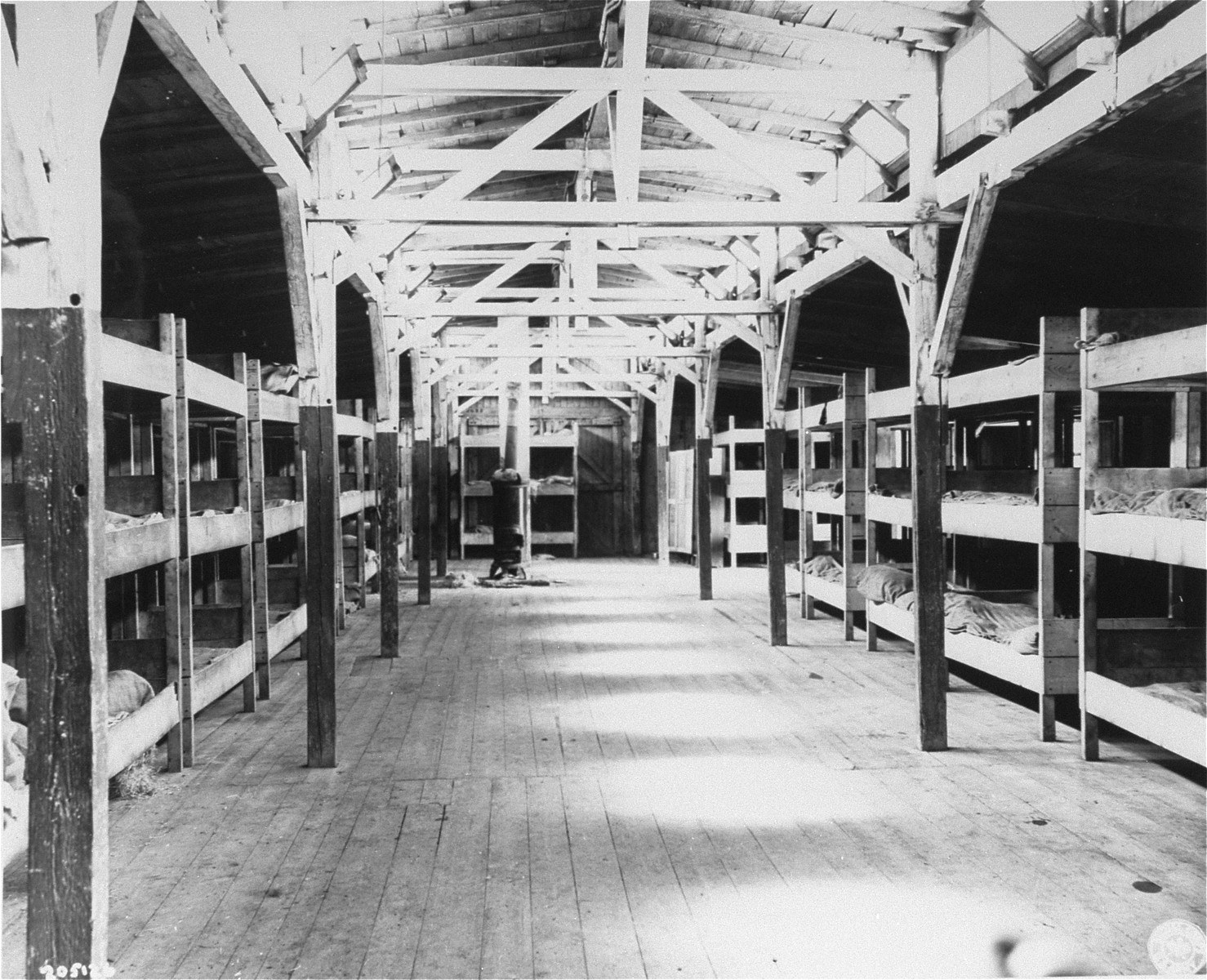
Barracks at Flossenbürg, photographed by U.S. forces after the camp's liberation in May 1945.
US Army Signal Corps. National Archives and Records Administration. Public domain.
- Type
- Concentration Camp
- Location
- Flossenbürg, northeastern Bavaria, Germany (near the prewar Czech border)
- Operational dates
- 3 May 1938 to 23 April 1945
- Liberation
- 23 April 1945, by US forces, the 90th Infantry DivisionMost prisoners had been evacuated on death marches between 15 and 20 April; just over 1,500 mostly ill prisoners remained when US forces arrived.
- Approximate prisoner count
- Nearly 97,000 prisoners passed through the system between 1938 and 1945, just over 16,000 of them women; peak population was nearly 53,000 in March 1945
- Approximate death toll
- An estimated 30,000 died in Flossenbürg, its subcamps, or on the evacuation routes (including 3,515 Jews)Estimated. The figure combines deaths in the main camp, the roughly 100 subcamps, and the death marches; precise totals across the dispersed system cannot be established.
- Primary prisoner categories
- Initially a camp for men the regime labeled 'asocial' and repeat criminal offenders, with a small number of gay men. From 1939 it received political prisoners (German, then Czech, Polish, and others) and Soviet prisoners of war, plus French prisoners held under the Night and Fog decree. Few Jews were held before 1944; from August 1944 at least 10,000 Jews, mostly Hungarian and Polish, arrived.
- Commandants
- Max Koegel was the camp's final and longest-serving commandant, from April 1943 until the end of the war; arrested by US forces in June 1946, he died by suicide in his cell before trial. (Earlier commandants were Jakob Weiseborn, Karl Künstler, and Egon Zill.)
Flossenbürg was established by the SS in 1938 in the granite hill country of northeastern Bavaria, chosen for the stone its prisoners would be forced to quarry for the SS-owned German Earth and Stone Works. Its first prisoners were men the regime classed as 'asocial' or criminal, joined over the following years by political prisoners from across occupied Europe, Soviet prisoners of war, and, from 1944, large numbers of Jews evacuated from camps in the east. By 1944 the camp and its roughly one hundred subcamps had become a center of armaments production, manufacturing parts for Messerschmitt aircraft. Flossenbürg is also remembered as the place where, in the final weeks of the war, the SS killed members of the German resistance, including theologian Dietrich Bonhoeffer and Admiral Wilhelm Canaris, after summary proceedings on 9 April 1945.
Subcamps
The SS established around 90 men's subcamps and more than 20 women's subcamps across Bavaria, Saxony, and the Bohemian lands. They included Altenhammer, Ansbach, Aue, Bayreuth, Most (Brüx), Chemnitz, several Dresden camps, Eichstätt, Flöha, Freiberg, Ganacker, Graslitz, Gröditz, Hainichen, Helmbrechts, Hersbruck, Holýšov (Holleischen), Hradištko, Johanngeorgenstadt, Leitmeritz (Litoměřice), Lengenfeld, Lovosice, Mehltheuer, Mittweida, Mülsen St Micheln, Neurohlau, Nossen, Nürnberg (Siemens-Schuckert), Obertraubling, Oederan, Plattling, several Plauen camps, Pottenstein, Rabštejn, Regensburg, Rochlitz, Saal an der Donau, Ostrov (Schlackenwerth), Schönheide, Seifhennersdorf, Stulln, Venusberg, Wilischthal, Wolkenburg, Würzburg, Zwickau, and Svatava (Zwodau), among others.