Simon Wiesenthal
1908 to 2005
Survivor; postwar Nazi-hunter.
Simon Wiesenthal was born on 31 December 1908 in Buczacz, then Austria-Hungary and now Ukraine, and trained as an architect. He survived a succession of camps, among them Janowska, Kraków-Płaszów, Gross-Rosen, a death march, and Buchenwald, before reaching Mauthausen in February 1945, where he was near death in a block for the dying when U.S. troops liberated the camp on 5 May 1945. Within about three weeks he had compiled a list of roughly one hundred suspected Nazi criminals and presented it to the American war-crimes office at the camp. In 1947 he co-founded the Jewish Historical Documentation Centre in Linz, beginning a life's work tracking fugitive perpetrators that made him the world's best-known Nazi-hunter. He died in 2005.
Jack Taylor
1908 to 1959
US Navy OSS officer; prisoner and liberation witness.
Jack Hendrick Taylor, born on 9 October 1908, was a U.S. Navy officer and one of the first members of the OSS Maritime Unit, a forerunner of the Navy SEALs. In October 1944 he parachuted into Austria on the 'Dupont Mission' to gather intelligence on German supply lines; the team was captured by the Gestapo, and in March 1945 Taylor was sent to the Mauthausen-Gusen complex. One of very few American prisoners in the camp, he was repeatedly slated for execution but was protected by fellow inmates and survived until the 11th Armored Division reached Mauthausen on 5 May 1945. His filmed account, recorded just after liberation, and his 1946 testimony at the U.S. trial of the camp staff were central to the convictions that followed. He died in 1959.
Hans Maršálek
1914 to 2011
Austrian-Czech survivor; the camp's principal historian.
Hans Maršálek was born on 19 July 1914 in Vienna to an ethnically Czech family and worked as a typesetter. A socialist active in the resistance, he was arrested in 1941 and deported to Mauthausen in September 1942, where he was assigned clerical work in the camp office and joined the in-camp resistance. After the war he served in the Austrian political police, helped track down Nazi criminals, and was a witness at the 1946 Mauthausen-Gusen trial. From 1946 he helped establish the Mauthausen Memorial, serving as its director until 1976 and building, largely single-handedly, the archive and documentation that underpins most reliable scholarship on the camp. He died on 9 December 2011, and the Austrian Mauthausen Committee's Hans Maršálek Prize is named for him.
Franz Ziereis
1905 to 1945
SS commandant of Mauthausen.
Franz Ziereis, born in 1905, replaced Albert Sauer as commandant of Mauthausen in 1939 and held the post until May 1945. U.S. troops captured him on 23 May 1945 in a mountain hut; he was shot during a reported escape attempt and died of his wounds a day or two later. Before his death, former prisoners interrogated him at the Gusen detention camp, and that deathbed testimony was available to prosecutors at the Nuremberg Trial.
Francesc Boix
1920 to 1951
Spanish Republican prisoner-photographer who preserved evidence.
Francesc Boix was a Catalan veteran of the Spanish Civil War, deported as a stateless Spanish Republican and held in the main Mauthausen camp from January 1941 until liberation in May 1945. Assigned to the camp's photographic identification service, he handled the SS's own images and, with help from fellow prisoners, secretly preserved roughly two thousand negatives. After the war he testified at the Nuremberg tribunal and at the U.S. Mauthausen trial, presenting photographs that helped convict Nazi defendants. He died in Paris in 1951, aged thirty.
Tibor Rubin
1929 to 2015
Hungarian-Jewish survivor; later U.S. Medal of Honor recipient.
Tibor Rubin was a Hungarian Jewish teenager deported to the main Mauthausen camp, where he was held for over a year until American troops liberated it in May 1945, having lost his parents and two sisters in the Holocaust. After emigrating to the United States he enlisted in the U.S. Army and served in the Korean War, where he was captured and credited with keeping fellow prisoners alive. In 2005 he received the Medal of Honor, the only known Holocaust survivor to be so honored. He died in 2015.
Albert Kosiek
dates not established
U.S. liberator, 11th Armored Division.
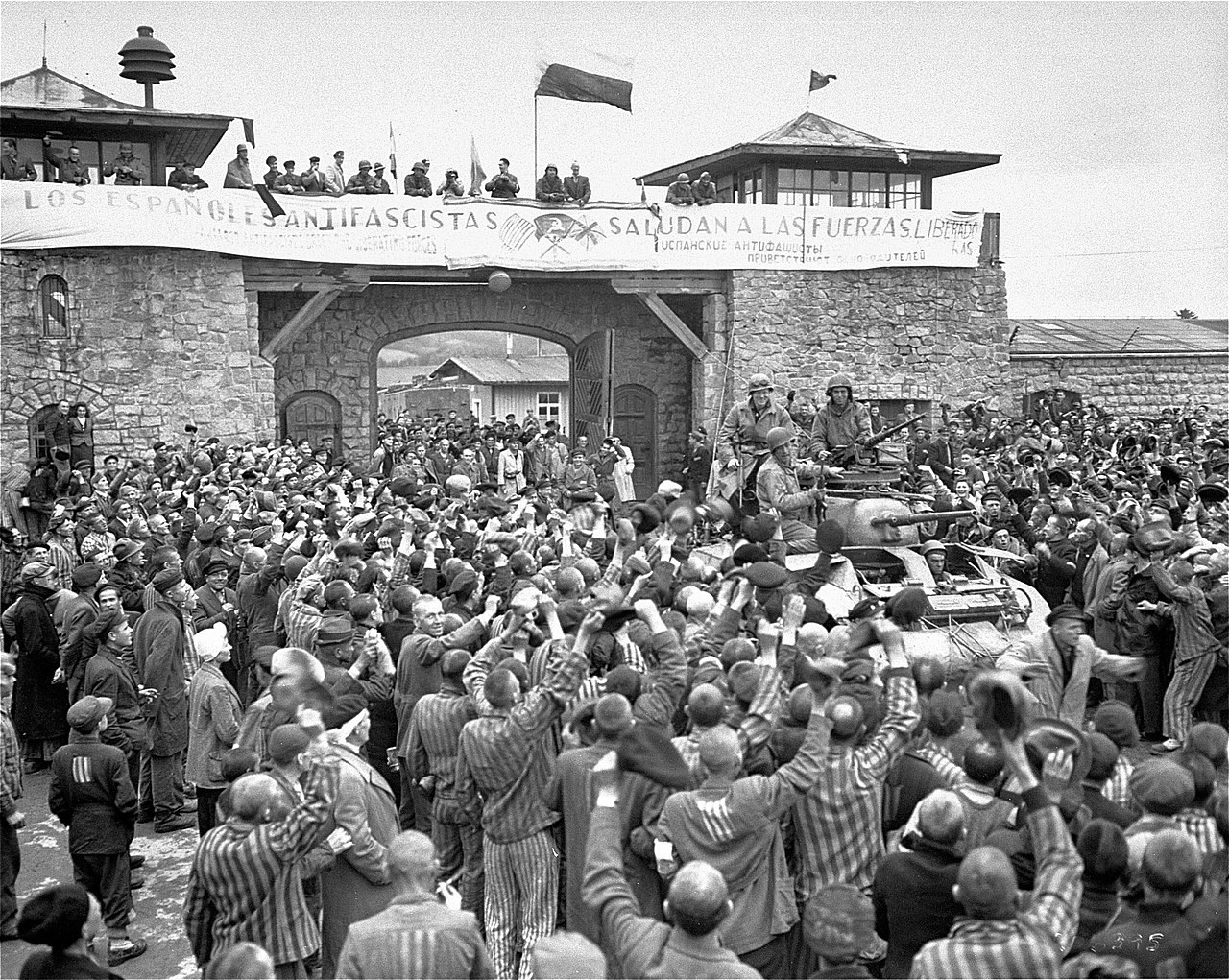
Albert Kosiek was a staff sergeant in the 41st Reconnaissance Squadron of the U.S. 11th Armored Division, Third Army. On 5 May 1945 he led a small patrol that reached the Mauthausen complex and accepted the camp's surrender. A son of Polish immigrants, he addressed the liberated prisoners in Polish. His patrol's arrival marked the liberation of the main camp and its tens of thousands of survivors.
Louis Haefliger
1904 to 1993
International Red Cross delegate; rescuer.
Louis Haefliger was a Swiss bank clerk who volunteered to escort an International Committee of the Red Cross relief convoy to the Mauthausen camps in late April 1945. Remaining at the main camp as the front approached, he worked to prevent the SS from carrying out destructive last-minute plans against the prisoners and helped guide American forces toward the camp. Reprimanded at the time by the ICRC for acting on his own initiative, he was later honored in Austria and Israel and formally rehabilitated by the ICRC in 1990.
Hans Bonarewitz
died 1942
Sinti prisoner; escapee.
Hans Bonarewitz was a Sinti prisoner held in the main Mauthausen camp and assigned to the Wienergraben quarry detail. In the summer of 1942 he escaped by concealing himself but was recaptured after about ten days. On 30 July 1942 he was executed before the assembled prisoners in a forced public display. His case became one of the best-documented instances of the SS staging a recaptured escapee's death as a warning to the camp.
August Eigruber
1907 to 1947
Nazi Gauleiter of Upper Austria.
August Eigruber was the Nazi Gauleiter and Reichsstatthalter of Upper Austria who in 1938 helped establish the Mauthausen complex by transferring land to the SS and backing its expansion. He stayed closely involved with the camp and, in the final weeks, ordered the killing of resistance prisoners there. Arrested by U.S. forces in 1945, he was convicted at the U.S. Mauthausen trial and executed at Landsberg prison in 1947.