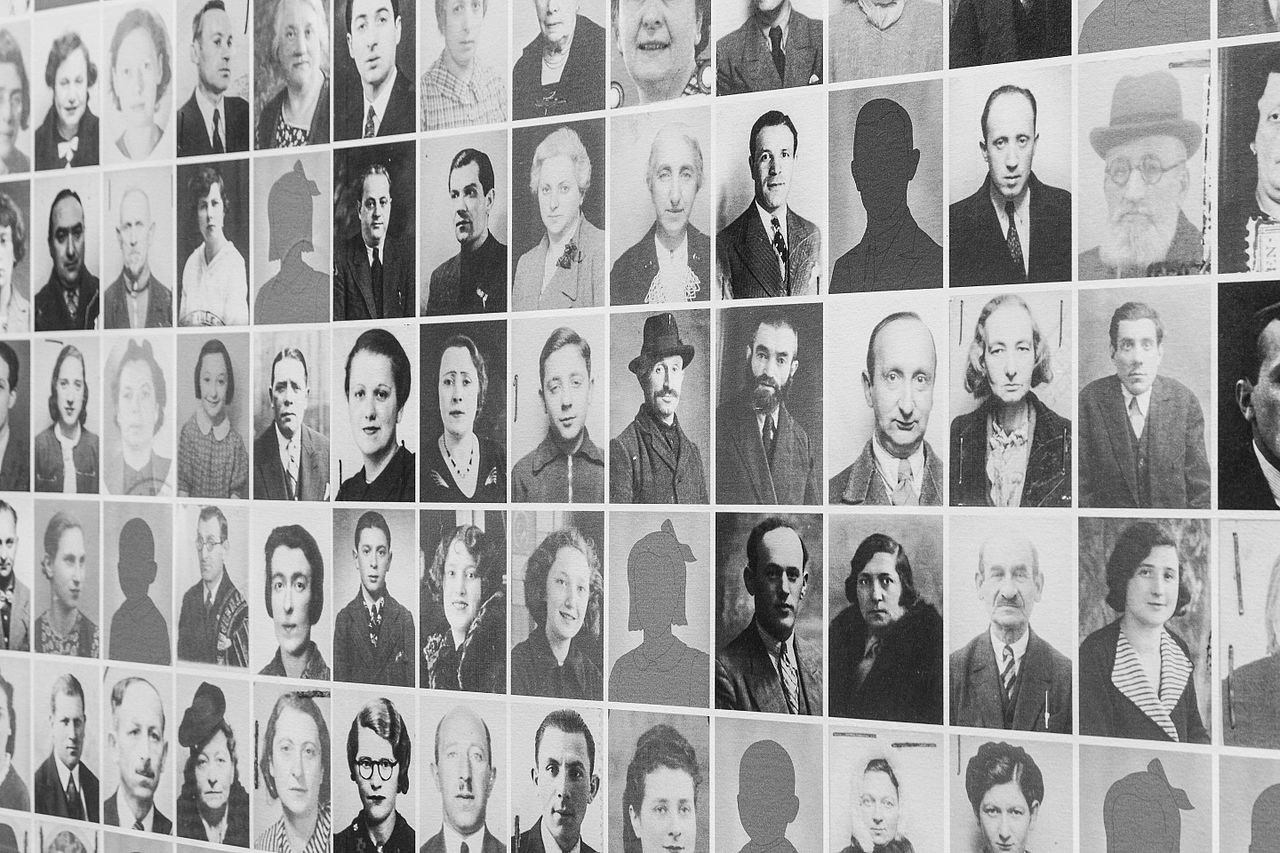
The wall of portraits at the Kazerne Dossin Memorial in Mechelen; silhouettes mark deportees whose photographs are unknown.
Memorial wall, Kazerne Dossin, Mechelen. Via Wikimedia Commons.
- Type
- Transit Camp
- Location
- Mechelen (Malines), the Dossin barracks, Belgium (midway between Antwerp and Brussels)
- Operational dates
- Dossin barracks converted to a transit camp in summer 1942; deportations August 1942 to July 1944; closed September 1944
- Liberation
- The Germans closed and abandoned the camp in September 1944 as Allied forces approached, leaving roughly 500 prisoners behindThere was no assault by a named liberating unit; the camp was vacated by the Germans during the Liberation of Belgium.
- Approximate prisoner count
- Between August 1942 and July 1944, 28 trains carried about 25,257 Jews (USHMM; the Kazerne Dossin memorial gives about 25,490) plus roughly 353 Roma to German-occupied Poland
- Approximate death toll
- Deaths at the camp itself were comparatively low; nearly all deportees were murdered after transport, most at Auschwitz-Birkenau. This represented more than half of the Belgian Jews murdered in the Holocaust; only about 1,240 of those deported survived.Mechelen was an assembly and dispatch point, not a killing site; the deaths occurred at Auschwitz-Birkenau and associated destinations. The Jewish total is given variously as ~25,257 (USHMM) and ~25,490 (Kazerne Dossin).
- Primary prisoner categories
- Jews and Roma. The great majority were Jews from Belgium, heavily the immigrant communities of Antwerp and Brussels, together with several trainloads of Roma deported in 1943 and early 1944.
- Commandants
- The camp was officially under Philipp Schmitt, commandant of Breendonk, who was tried in Belgium, sentenced to death in 1949, and executed in 1950, the last person executed in Belgium. The day-to-day commandant was SS officer Rudolph Steckmann, for whom a reliable trial outcome is not established.
The Dossin barracks sat in a crowded quarter of Mechelen, an old garrison building beside the Dijle midway between Antwerp and Brussels, chosen because the two cities held most of Belgium's Jews and the rail links ran east. From August 1942 the trains left in a brutal early rhythm, two transports of about a thousand people each week through the autumn of 1942, carrying Jews and, later, Roma toward Auschwitz-Birkenau. Belgian Jewish and resistance fighters managed the war's only armed attack on such a train, the 19 April 1943 ambush of the Twentieth Convoy, from which several hundred people escaped. Few died at Mechelen itself; it was the threshold before deportation, and more than half of all Belgian Jews murdered in the Holocaust passed through it. Of the roughly 25,000 deported, only about 1,240 survived.