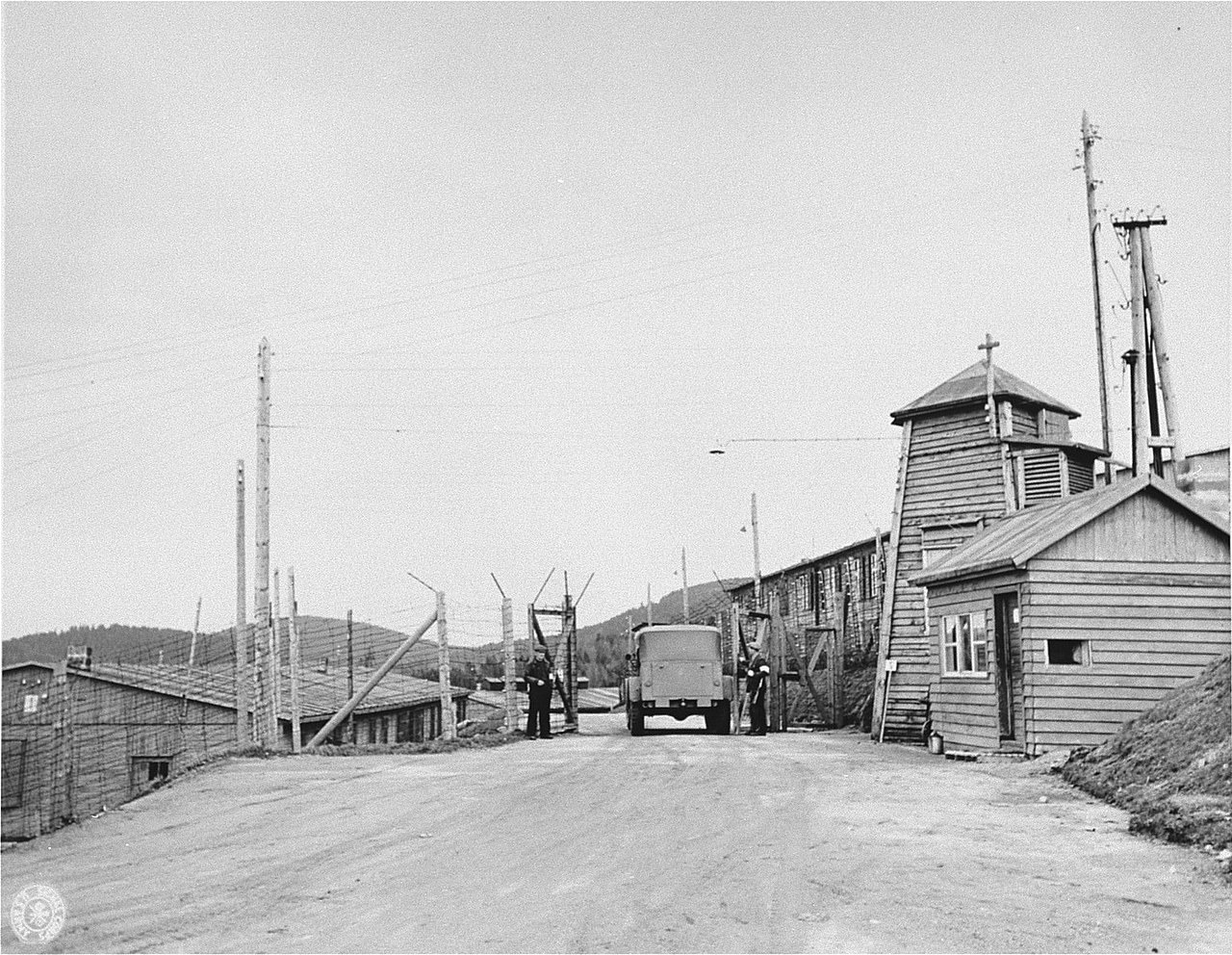
The gate of the Natzweiler-Struthof camp, on its terraced hillside in the Vosges, after liberation.
Natzweiler-Struthof concentration camp, after liberation. Public domain.
- Type
- Concentration Camp
- Location
- Natzwiller, Alsace, France (about 31 miles southwest of Strasbourg)
- Operational dates
- May 1941 to evacuated September 1944
- Liberation
- 23 November 1944; the abandoned main camp was reached by Allied forces (French First Army)The SS had already evacuated the main camp in September 1944, so Allied troops found it largely empty; it was the first concentration camp on Western European soil reached by the Western Allies.
- Approximate prisoner count
- Approximately 52,000 passed through the system, of some 32 nationalities; about 7,000 in the main camp and more than 20,000 in subcamps by fall 1944
- Approximate death toll
- Between 19,000 and 20,000 died in the camp system from 1941 to 1945USHMM gives 19,000 to 20,000. Higher figures (up to about 22,000) circulate but are not from USHMM and should be treated as contested.
- Primary prisoner categories
- From summer 1943 the camp held many 'Night and Fog' prisoners, captured resistance members from occupied Western Europe made to 'disappear' without notification to their families, including many of the French Resistance. Prisoners spanned roughly 32 nationalities. A group of Jewish prisoners and Roma transferred from Auschwitz were also held, as were captured Allied agents.
- Commandants
- Josef Kramer served as commandant from 1941; he was later tried by a British military court at the Belsen Trial for crimes at Bergen-Belsen and Auschwitz, not specifically for Natzweiler, and was hanged on 13 December 1945.
Natzweiler-Struthof was one of the smaller camps the Germans built, set high in the Vosges mountains of annexed Alsace about 31 miles from Strasbourg, and it holds the distinction of being the only concentration camp the Nazis established on French soil. Opened in May 1941, its prisoners drew labor for nearby granite quarries and, later, for underground armaments construction. From 1943 it became a principal destination for 'Night and Fog' prisoners, resistance fighters from across Western Europe who were meant to vanish without trace, and its inmates of some thirty nationalities included captured Allied agents. With Allied forces approaching, the SS evacuated the main camp in September 1944 and dispersed its prisoners; the empty site was reached by Allied troops on 23 November 1944, making it the first such camp the Western Allies encountered.
Subcamps
About 50 subcamps across Alsace, Lorraine, and the adjacent German provinces of Baden, Württemberg, and Hesse, most after the main camp's evacuation. They included Asbach (Obrigheim), Auerbach, Bad Rappenau, Balingen, Bisingen, Bruttig-Treis, Calw, Cernay, Colmar, Dautmergen, Echterdingen, Ellwangen, Frommern, Geislingen, Hailfingen-Tailfingen, Haslach, Heidenheim, Heppenheim, Hessenthal, Iffezheim, Kochendorf, Leonberg, Mosbach, Neckarbischofsheim, Neckarelz, Neckargerach, Neckargartach, Obernai, Offenburg, Rothau, Saint-Dié, Sainte-Marie-aux-Mines, Sandhofen, Schömberg, Schörzingen, Schwäbisch Hall, Spaichingen, Thil, Vaihingen, Walldorf, Wasseralfingen, Wesserling, and Zuffenhausen, among others.