All camps

Salaspils

Salaspils camp, Latvia

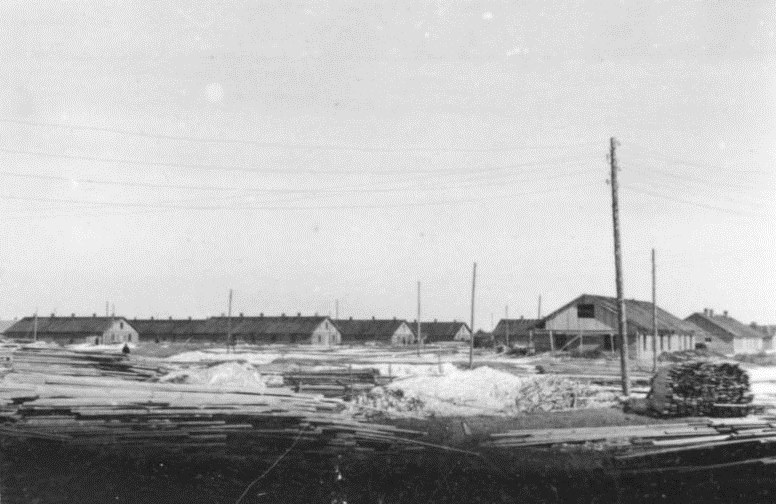
The Salaspils camp under construction in Latvia, its barracks rising behind stacks of building timber, around 1942.

Salaspils camp, Latvia, c. 1942. Public domain.

Type
Police prison and labor camp (widely described as a concentration camp)
Location
Salaspils, near Riga, German-occupied Latvia (Reichskommissariat Ostland)
Operational dates
Planned from October 1941; operational 1942 to autumn 1944
Liberation
Liquidated by the SS in autumn 1944 ahead of the Red ArmyRemaining prisoners were dispersed to other camps or penal units; the Riga area fell to Soviet forces in October 1944.
Approximate prisoner count
About 12,000 prisoners passed through the camp during its existence
Approximate death toll
Approximately 2,000 to 3,000 people diedSoviet-era claims that more than 100,000 died at Salaspils are now regarded as propaganda; current scholarship gives 2,000 to 3,000.
Primary prisoner categories
A shifting population: Jews deported from Germany, Austria, and Czechoslovakia who were forced to build the camp and largely died or were returned to Riga; Soviet prisoners of war; and, increasingly, Latvian and Baltic political prisoners, anti-Nazi partisans and their families, conscientious objectors, draft evaders, and deserters from the Latvian Legion. In 1943 around 1,100 children, most of them from partisan families, were held there.
Commandants
Rudolf Lange, who commanded the Security Police and SD in Latvia and established the camp, took part in the Wannsee Conference and died in 1945 without standing trial. Gerhard Kurt Maywald was later convicted in West Germany for crimes committed at the camp.

Salaspils was the largest civilian camp in Nazi-occupied Latvia, built from late 1941 on a site about eleven miles southeast of Riga and officially branded a police prison and re-education-through-labor camp. It was raised by Soviet prisoners of war and by Jews deported from Germany, Austria, and Czechoslovakia, most of whom died or were sent back to Riga before the barracks were finished. Over its existence it held a changing population of political prisoners, partisans and their families, and forced laborers, and roughly 12,000 people passed through its gates. Its most enduring association is with the children imprisoned there in 1943. After the war Soviet authorities vastly inflated the death toll for propaganda, but current scholarship places it at two to three thousand.
The people of Salaspils

Rudolf Lange

1910 to 1945

SS commander who established the camp.

Rudolf Lange commanded the Security Police and SD in occupied Latvia and led Einsatzkommando 2, a mobile killing unit, when he planned and established the Salaspils camp from late 1941. In February 1942 he took part in the Wannsee Conference, where the Nazi leadership coordinated the murder of Europe's Jews. He oversaw the camp in its roles as a police prison, a labor camp, and a holding site for Jews deported into Latvia. He died in early 1945 as the Reich collapsed and never stood trial.

Konrads Kalejs

1913 to 2001

Commander of the guard unit at the camp.

Konrads Kalejs led the men of the Latvian Arajs Kommando who guarded Salaspils from December 1941 to the end of 1943. After the war he emigrated and lived for decades in Australia and the United States, becoming one of the most prominent Nazi-era war-crimes suspects pursued in the West. He was stripped of residency and faced deportation proceedings in several countries before his death in Australia in 2001, his case never reaching a full trial.

Larry Pik

dates not established

Survivor of the camp.

Larry Pik was a prisoner at Salaspils who survived the war and later settled abroad. Decades afterward he funded the separate monument unveiled at the Salaspils memorial site in 2004 to commemorate the Jews deported from Germany, Austria, and Czechoslovakia who died there. The monument bears an inscription in Hebrew, Latvian, and German.

The children of Salaspils

1942 to 1944

Child prisoners.

By March 1943 around 1,100 children were imprisoned at Salaspils, most of them taken with the families of anti-Nazi partisans during German sweeps of the countryside. They were held in their own barracks, and about half are believed to have died of typhoid, measles, and other diseases before the children's camp was broken up in May 1943 and the survivors dispersed to orphanages and farms. Their fate became the camp's most enduring memory, marked by memorials and, in the postwar decades, by song.

Subcamps

None. Salaspils was a single camp of some fifty-nine structures; it stood within the wider Riga-area camp system that also included the Riga Ghetto, Jungfernhof, and Kaiserwald, which were separate sites.

Further reading by Erin Faith Allen

Researched and written by · Fortitude Research

Work with Erin

Tell me who
you are looking for.

Start the search About Erin