All camps

Kaiserwald

Riga-Kaiserwald concentration camp

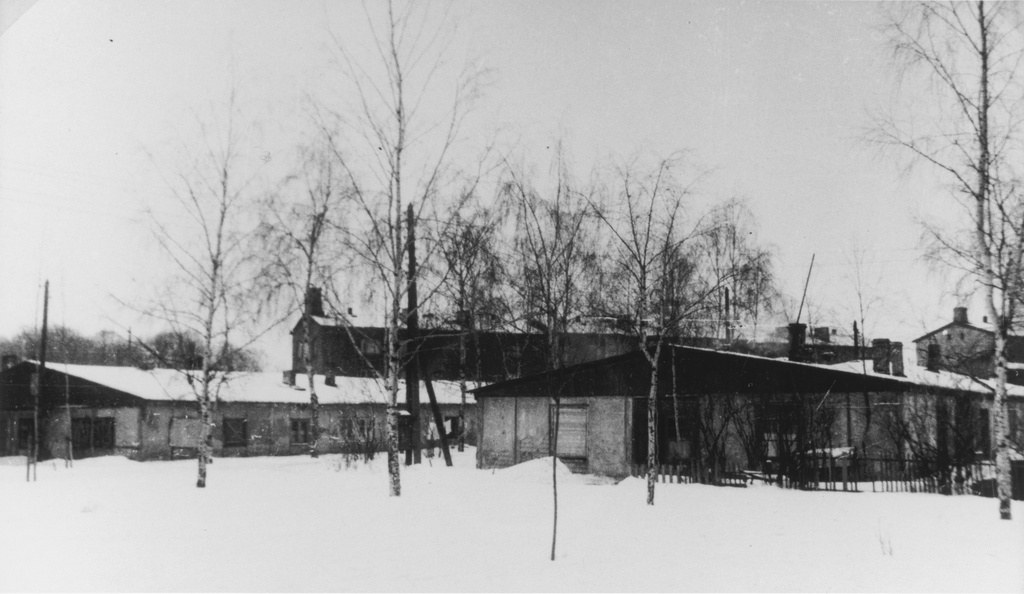
The Riga-Kaiserwald camp in winter, its barracks standing among the birches.

Staatsanwaltschaft beim Landgericht Hamburg; provenance Josef Schneider, file 141 Js 534/60, photo 48.

Type
Concentration Camp
Location
Mezaparks (Kaiserwald), a northern suburb of Riga, German-occupied Latvia (Reichskommissariat Ostland)
Operational dates
15 March 1943 to autumn 1944
Liberation
Evacuated and liquidated in summer 1944; the site was taken by the Red Army on 15 October 1944From August 1944 the SS shipped surviving prisoners by sea to Stutthof; those judged unable to make the journey were killed beforehand.
Approximate prisoner count
By March 1944 the camp and its subcamps held 11,878 prisoners (6,182 men and 5,696 women), almost all of them Jews
Approximate death toll
An aggregate death toll for the camp is not reliably establishedDeaths came from forced labor and harsh conditions and from the killing of prisoners judged unfit during the 1944 evacuation; the 1941 Rumbula massacre figures belong to the earlier ghetto phase, not to this camp.
Primary prisoner categories
Overwhelmingly Jews. After the Riga, Liepaja, and Daugavpils ghettos were destroyed in 1943, the surviving Jews of Latvia and most survivors of the Vilna ghetto were concentrated here; from 1944, Hungarian Jews and Jews from Lodz were also sent. A small number of non-Jewish prisoners and several hundred German convicts, the camp's first inmates, were also held. The camp anchored a network of forced-labor subcamps around Riga.
Commandants
Albert Sauer, who had served in the SS camp system at Sachsenhausen and Mauthausen, commanded Kaiserwald from its founding in March 1943 and was never tried, dying of wounds in May 1945. (Eduard Roschmann, the so-called 'Butcher of Riga,' commanded the Riga Ghetto rather than Kaiserwald, despite a popular conflation drawn from fiction.)

Konzentrationslager Riga-Kaiserwald was the principal SS concentration camp in the occupied Baltic, opened in March 1943 in a wooded suburb on the north edge of Riga. When the Nazis destroyed the ghettos of Riga, Liepaja, and Daugavpils that June, the surviving Jews of Latvia, soon joined by survivors of the Vilna ghetto and, later, Jewish prisoners from Hungary and Lodz, were concentrated here under the SS camp administration. Kaiserwald was not a killing center but a hub of forced labor, governing a wide network of subcamps around Riga whose prisoners were leased to German firms, most prominently the electrical conglomerate AEG. By March 1944 nearly 11,900 prisoners were held in the camp and its satellites. As the Red Army pressed into Latvia in the summer of 1944, the SS dissolved the camp and shipped the survivors by sea to Stutthof, leaving the site to be occupied by Soviet forces that October.

The people of Kaiserwald

Gertrude Schneider

1928 to 2020

Survivor; later historian of the Riga ghetto and camps.

Gertrude Schneider, born Gertrude Maier in Vienna in 1928, was deported with her family to the Riga ghetto in February 1942, where as a teenager she kept a diary of ghetto life. In 1943 the family was deported to Kaiserwald, and in 1944 onward to Stutthof; she survived slave labor and a death march and was liberated in March 1945 with her mother and sister. Emigrating to the United States, she earned a doctorate in history and became one of the foremost survivor-historians of the Latvian Holocaust, joining eyewitness testimony to archival research and recovering the fates of Austrian Jews deported east. She lectured and testified into her later years and died in 2020.

Joseph Berman

1925 to 1995

Survivor; postwar war-crimes witness and investigator.

Joseph Berman was born in Ventspils, Latvia, in 1925 and was imprisoned during the German occupation at Kaiserwald near Riga and later in the Courland camps, at one point forced to clean vehicles at the Gestapo headquarters, where he observed SS personnel directly. He survived and was ultimately liberated at Buchenwald. After the war he became a significant figure in documenting Nazi crimes, advising the prosecution and appearing as a rebuttal witness at the 1947 Buchenwald trial and working as an investigator for the U.S. military government in Bavaria. His detailed sworn testimony named and described the conduct of SS perpetrators in Latvia. He died in 1995.

Lily Mazur Margules

dates not established

Survivor; Vilna ghetto, Kaiserwald, and Stutthof.

Lily Mazur Margules was forced into the Vilna ghetto after the German occupation of 1941 and performed forced labor until the ghetto's liquidation in 1943, when she was deported to Kaiserwald near Riga. From the main camp she was assigned to the Dunawerke labor subcamp, then transported by sea to Stutthof and on to a nearby labor camp, surviving a death march that ended at Krumau in East Prussia in 1945. In her recorded testimony she describes the deliberate stripping away of prisoners' dignity on arrival and the fear that she and her younger sister would be killed.

Also featured on the Stutthof page

Steven Springfield

born 1923

Survivor; Riga ghetto, Kaiserwald, and Stutthof.

Steven Springfield, a Latvian Jew from Riga born in 1923, and his brother were confined in the Riga ghetto after the 1941 occupation, surviving while most of the ghetto was destroyed. In 1943 he was deported to Kaiserwald and assigned to forced labor, and in 1944 transferred to Stutthof, where he was put to work for a shipbuilding firm. He and his brother survived a death march and Soviet liberation in 1945, and he later gave extensive testimony on the Riga ghetto and the camps. He became president of the U.S. organization Jewish Survivors of Latvia.

Also featured on the Stutthof page

Sara Bialovadska

born c. 1929

Child prisoner at the camp.

Sara Bialovadska was a fourteen-year-old girl imprisoned in the Kaiserwald camp near Riga, photographed there in camp uniform in 1943. Her surviving portrait, held by the YIVO Institute for Jewish Research, is one of the few personal images that directly document an inmate of the main camp. It places a named young face on the Latvian and Baltic Jews concentrated at Kaiserwald after the ghettos were destroyed. Beyond the photograph and its caption, little of her life is recorded.

Albert Sauer

1898 to 1945

SS commandant of Kaiserwald.

Albert Sauer was the founding commandant of Riga-Kaiserwald, in command from the camp's establishment in March 1943 until its evacuation in 1944. A career concentration-camp officer, he had previously served in the SS administration at Sachsenhausen and Mauthausen. Under his command the main camp and its subcamps were organized around leasing Jewish prisoners as forced labor to German industry. He was never brought to trial: severely wounded in the closing days of the war, he died on 3 May 1945.

Subcamps

The camp anchored a network of forced-labor subcamps around Riga, among them Strasdenhof (the AEG works), Balastdamm, Dunawerke, Spilve, Lenta, Muhlgraben, the army motor-vehicle park (HKP), and the railway detail, with further satellite sites in Riga and in Courland such as Dundaga.
Researched and written by · Fortitude Research

Work with Erin

Tell me who
you are looking for.

Start the search About Erin