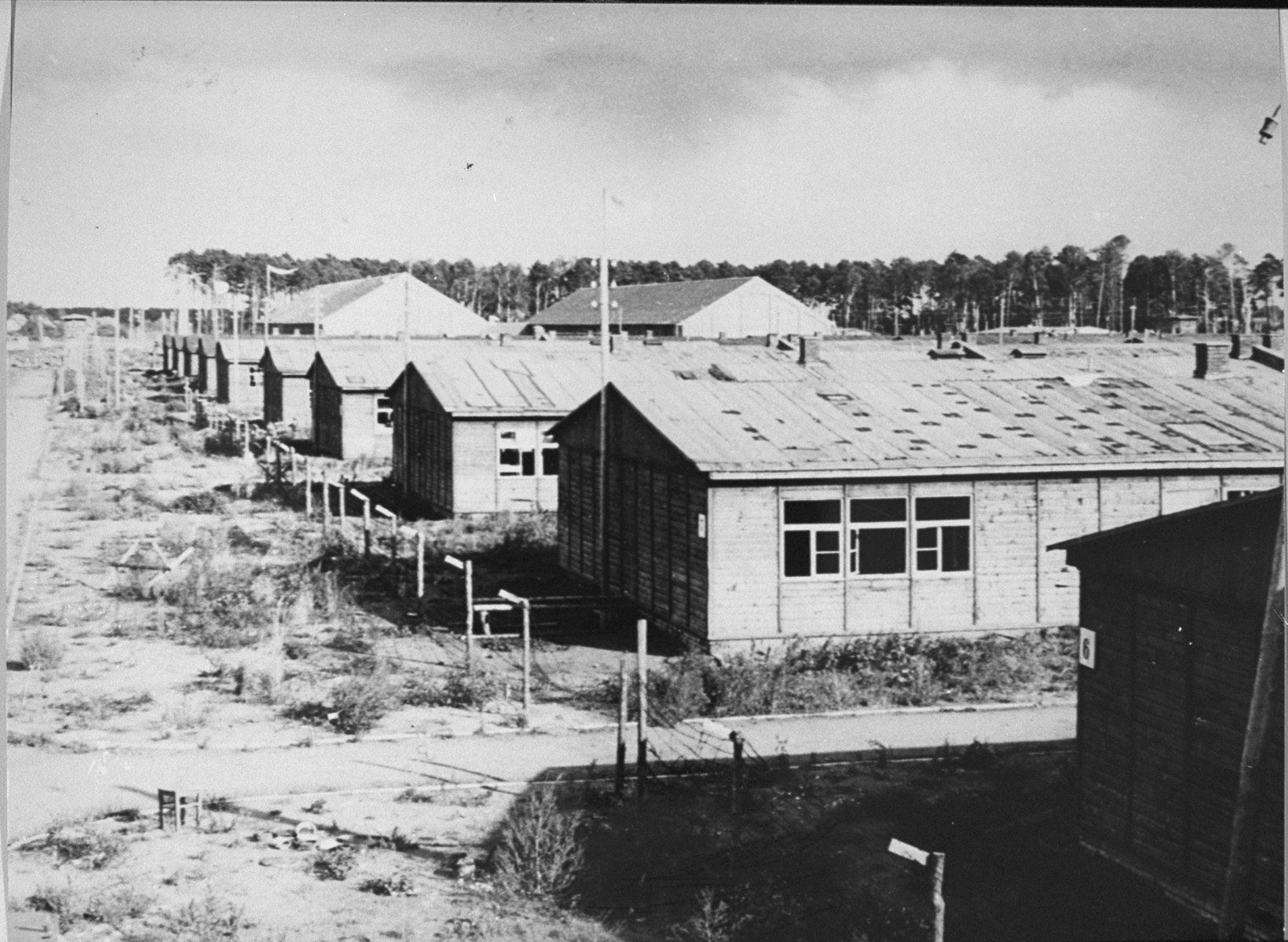
Barracks at Stutthof, photographed after the camp's liberation in 1945.
Stutthof concentration camp, 1945. Public domain.
- Type
- Concentration Camp
- Location
- Sztutowo (Stutthof), German-occupied Poland (near Danzig/Gdańsk)
- Operational dates
- 2 September 1939 (as a civilian internment camp; a regular concentration camp from January 1942) to 9 May 1945
- Liberation
- 9 May 1945, by Soviet forcesSoviet forces freed only about 100 prisoners who had hidden during the final evacuation; the camp had already been largely emptied by sea and land.
- Approximate prisoner count
- Perhaps as many as 100,000 prisoners were deported there over the camp's existence
- Approximate death toll
- More than 60,000 diedApproximate. USHMM further estimates that over 25,000 prisoners died during the evacuations and death marches of early 1945, so the total across the system is contested.
- Primary prisoner categories
- Mainly non-Jewish Poles in the early years, including political detainees and members of the Polish intelligentsia from the Danzig region. From 1944 the population shifted heavily toward Jews, including Polish Jews from Warsaw and Białystok and Jews evacuated from forced-labor camps in the occupied Baltic states.
- Commandants
- Max Pauly commanded Stutthof from 1939 to August 1942; he was later tried by a British military court for crimes at Neuengamme, not Stutthof, and executed in 1946. Paul-Werner Hoppe was commandant from 1942 to January 1945; tried in West Germany, he was convicted as an accessory to murder in 1955 and released in 1960.
The Germans built Stutthof in September 1939 in a wooded, marshy stretch of land near the Baltic coast about 22 miles east of Danzig, making it the first camp established outside Germany's prewar borders. It began as a civilian internment site under the Danzig police chief, became a 'labor education' camp in November 1941, and was designated a regular concentration camp in January 1942. Over six years tens of thousands passed through its gates, at first mainly non-Jewish Poles and from 1944 increasingly Jews evacuated from the Baltic states, and it grew into a network of more than a hundred subcamps feeding forced labor to SS enterprises, brickyards, agriculture, and armaments work. As Soviet forces closed in during the winter of 1945, the camp's prisoners were driven out in catastrophic land and sea evacuations in which roughly half are estimated to have died. Soviet troops reached the largely emptied camp on 9 May 1945, liberating about a hundred survivors who had hidden.
Subcamps
The SS established 105 subcamps across northern and central German-occupied Poland; the largest were Thorn (Toruń) and Elbing (Elbląg). Documented sites included Bocień, Brusy, Bromberg (Bydgoszcz), Danzig-Burggraben, the Elbląg camps, Garczyn, Gdańsk, Gdynia, Gerdenau, Grenzdorf, Grodno, Graudenz (Grudziądz), Gutowo, Heiligenbeil, Jesau, Kokoszki, Krzemieniewo, Lauenburg (Lębork), Matzkau, Nawitz, Obrzycko, Pelplin, Police (Pölitz), Praust (Pruszcz Gdański), Russoschin, Schippenbeil, Schönwarling, Sophienwalde, Preußisch Stargard (Starogard Gdański), Stolp (Słupsk), Thorn (Toruń), and many smaller work details, among others. The complete roster of all 105 is documented by the Stutthof Museum.